From 16 November 2026 the Digital Work Card becomes mandatory, with penalties, for seven more sectors: consulting firms, head offices, advertising, business support offices, warehousing, repair shops, waste management and gambling. For many small businesses with office staff, this is the first time working time will be recorded electronically and checked in real time.
Below we look at the topic from two angles: what Greek labour law provides and what it means for payroll and the books of the business.
16/11/2026
Full application and penalties for the second group of sectors
15 minutes
Maximum time to transmit each clock-in to ERGANI II
10.500 €
Maximum fine per employee without a work card
The legal framework in one paragraph
The Digital Work Card is governed by Ministerial Decision 49758/26.05.2022 (Gazette B΄ 2668), as in force, and articles 580 and 581 of the Greek Labour Law Code (P.D. 62/2025). In 2026 it was extended in two phases: MD 15441/2026 (B΄ 3051) brought in the first group, with penalties from 12/10/2026, and MD 18047/2026 (B΄ 3791) the second group, with a pilot from 29/6/2026 and penalties from 16/11/2026. The practical details are set out in the Ministry of Labour’s interpretative circular 25291/23.09.2026.
Is your business covered?
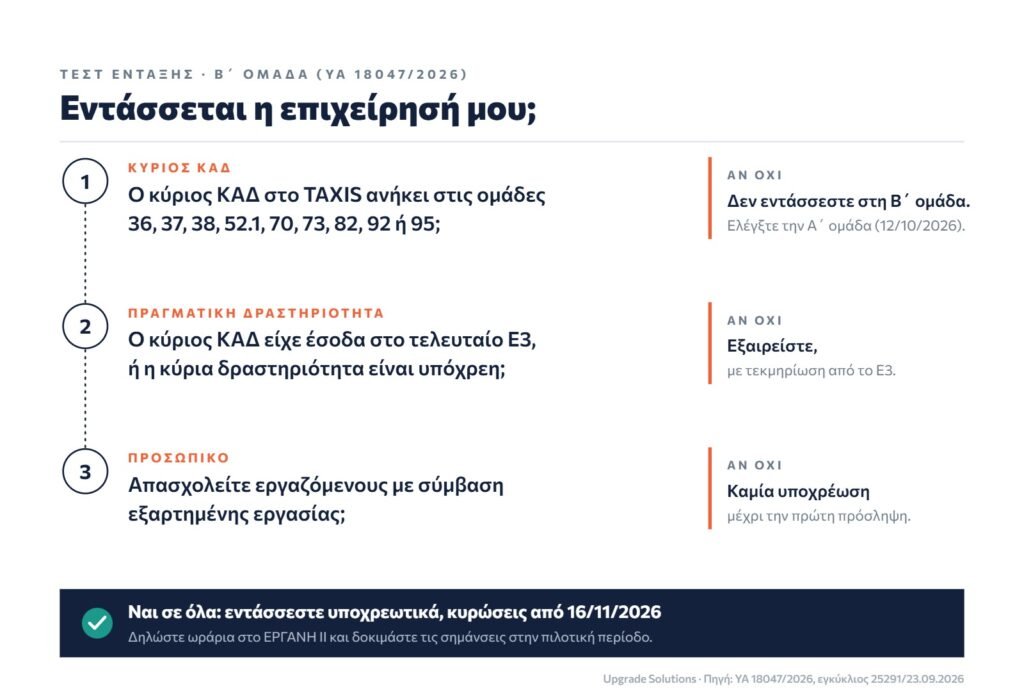
The key factor is your main activity code (KAD) in TAXIS. If it does not belong to the covered sectors, the whole business is exempt, even if it carries on a covered activity as a secondary one or has a branch with such a code. There is also an exception few people know: if the main KAD is covered but shows no revenue in the E3 form of the last financial year, and the actual main activity is not covered, the business is exempt.
| Sector (second group) | Main KAD |
|---|---|
| Water collection and treatment, sewerage, waste, remediation | 36, 37, 38 |
| Warehousing and support activities for transportation | 52.1 |
| Head offices, management consultancy activities | 70 |
| Advertising, market research, public relations | 73 |
| Office administrative and business support activities | 82 |
| Gambling and betting | 92 |
| Repair of computers, personal and household goods, vehicles | 95 |
The detailed activity codes (up to five digits) are listed in tables 12–18 of MD 18047/2026. The first group, already in force, includes IT and telecommunications, health and social care, employment and cleaning services, hairdressers, beauty centres and funeral services.
Which employees clock in and which do not
| Category | Work card? | Labour lawyer’s note |
|---|---|---|
| Full-time at the business premises | Yes | Two clock-ins a day, at the usual place of work. |
| Part-time | Yes | Two clock-ins for a continuous schedule, four for a split shift. |
| Teleworking | No | Only for teleworking days declared in advance. |
| Field work | No / Yes | No on days spent off-site. Yes when the employee comes to the business premises. |
| Permanently at an exclusive-use customer site | Yes | Clocks in there, e.g. a technician or a shop-in-shop. |
| Managerial staff | No | Declared in the working-time organisation without a digital schedule. |
| Employees on loan (temporary agency) | Yes | The obligation also covers employee lending. |
The rules and what they mean in practice
| Rule | In practice |
|---|---|
| Transmission to ERGANI II within 15 minutes | Applies to every channel (app, scanner, API). A delay counts as a failure. |
| Even number of clock-ins per day | Every clock-in needs a clock-out. Up to 3 unmatched clock-ins per employee per month are tolerated. |
| 10-minute preparation time | The employee may clock in up to 10 minutes before the start and clock out up to 10 minutes after the end. |
| Flexible arrival up to 120 minutes | Only with a written agreement (article 580 par. 2A of the Labour Law Code). Earlier arrival is not allowed. |
| Schedule changes: advance or retrospective system | Under the retrospective system, the choice is declared by the end of the month and changes are recorded by the end of the following month. |
| Technical problem | Notify the Labour Inspectorate within 24 hours at the latest and make a late declaration in ERGANI II. |
| Employee mistakes | The employer may not cut pay or charge leave. Systematic refusal is dealt with through the employment contract or the work regulations. |
The accountant’s view: work card, payroll and tax
- The work card “shows” the payroll. Any deviation from the declared schedule that has not been recorded as additional work or overtime is both a labour law violation and a likely payroll error. Premiums must be paid and declared in line with what is recorded in ERGANI II.
- Monthly reconciliation before the APD. We recommend comparing clock-ins, declared changes and payroll every month, before submitting the social security return (APD) to e-EFKA.
- Fines are not deductible. Administrative fines are not a tax-deductible expense (article 23 of the Greek Income Tax Code), so their real cost is higher.
- Compliance costs are deductible. Spending on software, scanners or provider subscriptions is an ordinary business expense.
- Personal data. Clock-ins are personal data and employees must be informed in writing about their processing, in line with the GDPR.
Fines: which violation, how much it costs
Penalties are imposed by the Labour Inspectorate, based on Annexes V and VI of MD 80016/31.08.2022 and articles 580 and 586 of the Labour Law Code. The main amounts, as announced by the Ministry of Labour:
| Violation | Fine |
|---|---|
| Employee working without the Digital Work Card being applied | up to €10,500 per employee |
| Actual working time different from the declared time | €3,000 per case |
| Obstructing proof of working time by deleting data | 4.000 € |
In an inspection, a fine is also imposed when an employee is found working before the declared start without a clock-in, or after the end of the schedule even if they have clocked out. From a labour law perspective, work card data is also evidence in future disputes over unpaid additional work or overtime.
Two inspection scenarios
Scenario 1: Consulting company (IKE) with five employees
Main KAD in group 70. Three employees work 09:00–17:00, one is part-time on a split shift, and one consultant teleworks two days a week. What the inspector will check: whether the three have two clock-ins a day and the part-timer four, whether the teleworking days are declared, and whether anyone who stayed after 17:00 has a recorded change. What the accountant checks: that the hours after 17:00 were paid with the correct premium in that month’s payroll.
Scenario 2: Repair shop with an office and field technicians
Main KAD 95. Two office employees clock in normally. Two technicians visit customers and do not clock in on off-site days, but do clock in when they stop by the workshop. The fifth is permanently placed at an exclusive-use customer site, so clocks in there. Common mistake: the technician stops by the workshop in the morning to pick up materials without clocking in. That day does not count as “off-site”.
Four-week preparation plan
| Week | Actions |
|---|---|
| Week 1 | Confirm the main KAD in TAXIS and the E3 form. List all employees by category (office, teleworking, field, managerial). |
| Week 2 | Update the digital working-time organisation in ERGANI II. Choose the advance or retrospective system. |
| Week 3 | Choose the clock-in method (app or scanner), run tests and sign written agreements for flexible arrival. |
| Week 4 | Inform employees in writing (including on personal data), appoint a person responsible for checks and a procedure for technical problems. |
Questions employers ask us
I have KAD 70 only as a secondary code. Am I covered?
No, if your main KAD in TAXIS is not a covered one.
An employee often forgets to clock in. Can I deduct it from their pay?
No. Offsetting pay or charging leave for work card mistakes is prohibited. Repeated failure is dealt with through disciplinary means, under the contract or the work regulations.
What if ERGANI or the internet goes down?
Notify the Labour Inspectorate within 24 hours at the latest, then make a late declaration with the missing clock-ins.
Can I declare overtime after the fact?
Yes, with the retrospective system. You choose it by the last day of the month and record the changes by the end of the following month.
An employee arrives 20 minutes early “for coffee”. Is that a problem?
Yes. Beyond the 10-minute preparation time, presence before the schedule without a declared change may be treated as work outside working hours and lead to a fine.
Do managerial staff clock in?
No. They must, however, be declared in the working-time organisation.
Need help with implementation?
Upgrade Solutions checks whether you are covered, sets up schedules in ERGANI II, trains your staff and links the work card to your payroll, so you are ready before 16 November. Write to us at info@upgradesolutions.gr.
Read also: Documents employers no longer have to keep at the workplace · All types of parental leave, explained simply
Sources: MD 49758/2022 (B΄ 2668) as in force, MD 15441/2026 (B΄ 3051), MD 18047/2026 (B΄ 3791), circular 25291/23.09.2026, MD 80016/31.08.2022, P.D. 62/2025 (Labour Law Code), Law 4172/2013 (Income Tax Code). Photos: Unsplash.
This article is for information purposes only and does not replace specialised professional advice.