From 2 November 2026, e-invoicing becomes mandatory for small businesses too: every invoice to another business or to the public sector must be issued electronically. AADE granted a one-month extension and, so far, no further extension has been announced. Here is what applies, which deadlines matter and which route to choose.
At a glance
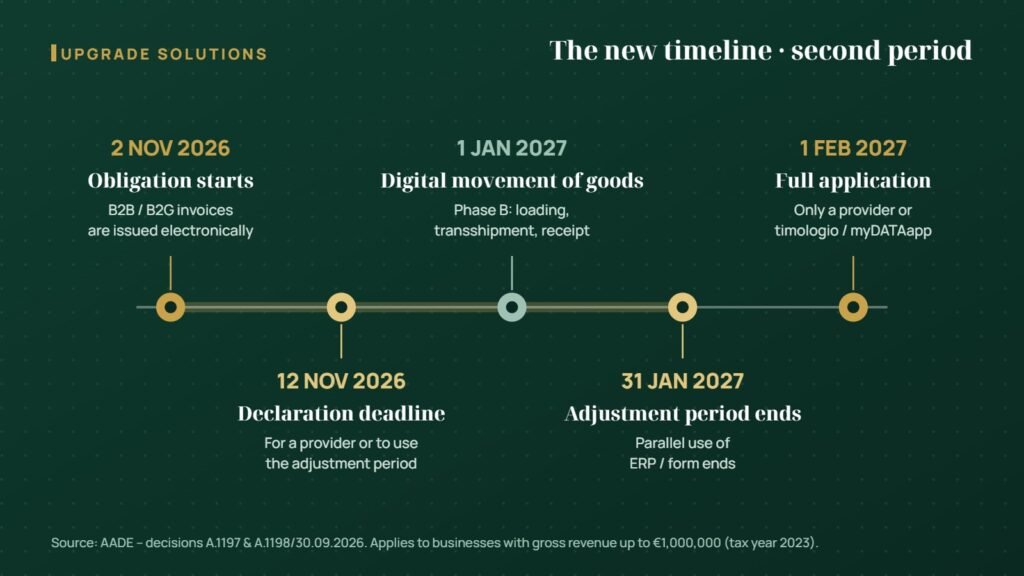
- 2 November 2026: mandatory e-invoicing starts for businesses with gross revenue up to €1,000,000.
- By 12 November 2026: deadline for the start declaration, where required.
- 2/11/2026 – 31/1/2027: adjustment period, with the option of parallel use of your ERP.
- From 1 February 2027: invoices only through a certified provider or the free timologio / myDATAapp applications.
- 1 January 2027: Phase B of the digital movement of goods also begins.
The new e-invoicing timeline
Originally, the second period of mandatory e-invoicing was to start on 1 October 2026. With decisions A.1197 and A.1198/30.09.2026, the Ministry of Finance and AADE moved the start to 2 November 2026. The transitional period was moved as well and now runs until 31 January 2027.
According to AADE data, about 655,000 businesses — almost 70% of second-period businesses that issue wholesale invoices — already use a certified provider or AADE’s applications. The extra month was given so that those lagging behind can complete the transition.
Who is affected
The second period covers all businesses not already included in the first period, i.e. those that declared gross revenue up to €1,000,000 in their tax return for tax year 2023. In practice: private companies (IKE), general and limited partnerships (OE, EE), small SAs, sole proprietorships and self-employed professionals who invoice other businesses.
The second period also includes businesses that have no tax return for tax year 2023, because they started later or are starting now. For them, the obligation applies from the first B2B or B2G invoice they issue after 2/11/2026.
Which transactions are covered
| Transaction | E-invoice required? |
|---|---|
| Sales / services to a Greek business (B2B) | Yes, mandatory |
| Invoices to the State and general government bodies (B2G) | Yes, mandatory |
| Sales to businesses in non-EU countries | Yes, mandatory |
| Sale of a fixed asset to a business (e.g. a company car) | Yes, it is B2B |
| Retail sales to consumers (B2C) | No, nothing changes |
| Intra-EU sales (to EU countries) | No |
Special cases that are often forgotten
- Purchase documents (self-issued for purchases): when you buy from private individuals or from farmers under the special scheme and you issue the purchase document yourself, it falls under the obligation and must be issued electronically.
- Self-billing: the obligation follows whoever issues the document. If your counterparty invoices on your behalf, the obligation is theirs.
- Credit notes to businesses follow the same rule as invoices.
Remember: as recipients, all businesses have already been obliged since 2 March 2026 to accept the e-invoices they receive from suppliers.
Provider or timologio? The two legal routes
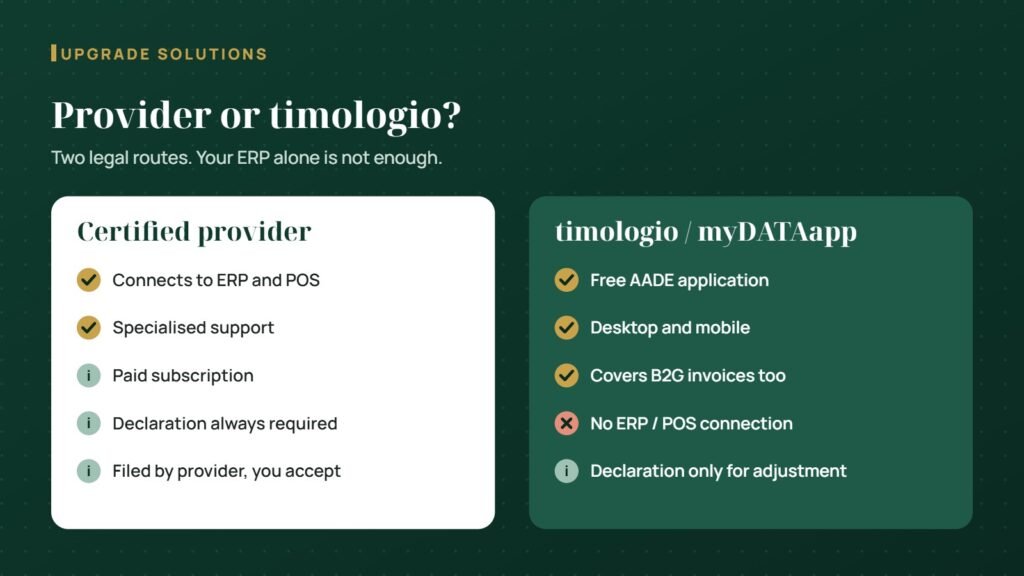
There are only two ways to issue an e-invoice. Your ERP or accounting software on its own is not an accepted method: it can keep running for management purposes, but issuance must go through a certified provider or AADE’s application.
1. Certified e-invoicing provider (YPAHES)
A private subscription service that connects to your commercial software, ERP or POS. It is the practical solution for businesses with many invoices or inventory. You can also use more than one provider.
2. Free AADE applications: timologio and myDATAapp
timologio (for computers) and myDATAapp (for mobile) are free, with no usage limit, and also cover invoices to the public sector. However, they do not connect to an ERP or POS, so they mainly suit self-employed professionals and businesses issuing a small number of invoices.
Is a declaration needed? It depends on the route
| Option | Start declaration | Who submits it |
|---|---|---|
| Certified provider | Always, with a start date of 2/11/2026 (or earlier) | The provider, within 10 days. You accept it in myAADE |
| timologio / myDATAapp only | No | — |
| timologio + ERP in parallel until 31/1/2027 | Yes, by 12/11/2026 | You, in myAADE, selecting “timologio” |
Note: the adjustment period is not automatic. It applies only if a timely declaration has been filed with a start date no later than 2/11/2026. If the provider does not submit the declaration within the 10 days, the business itself must do so within the following 10 days.
What the penalties are
According to circular E.2004/2026, an invoice not issued through one of the two legal routes is deemed not to have been issued at all. The penalties of article 57 of the Greek Code of Tax Procedure therefore apply:
- Transactions subject to VAT: 50% of the VAT, with a minimum of €250 (single-entry books) or €500 (double-entry books). On repetition the rate rises to 100% and then 200%, with minimums up to €2,000.
- Transactions without VAT: €500 (single-entry) or €1,000 (double-entry) per audit.
An exception applies only for loss of connection, such as a power or internet outage.
Digital movement of goods, too
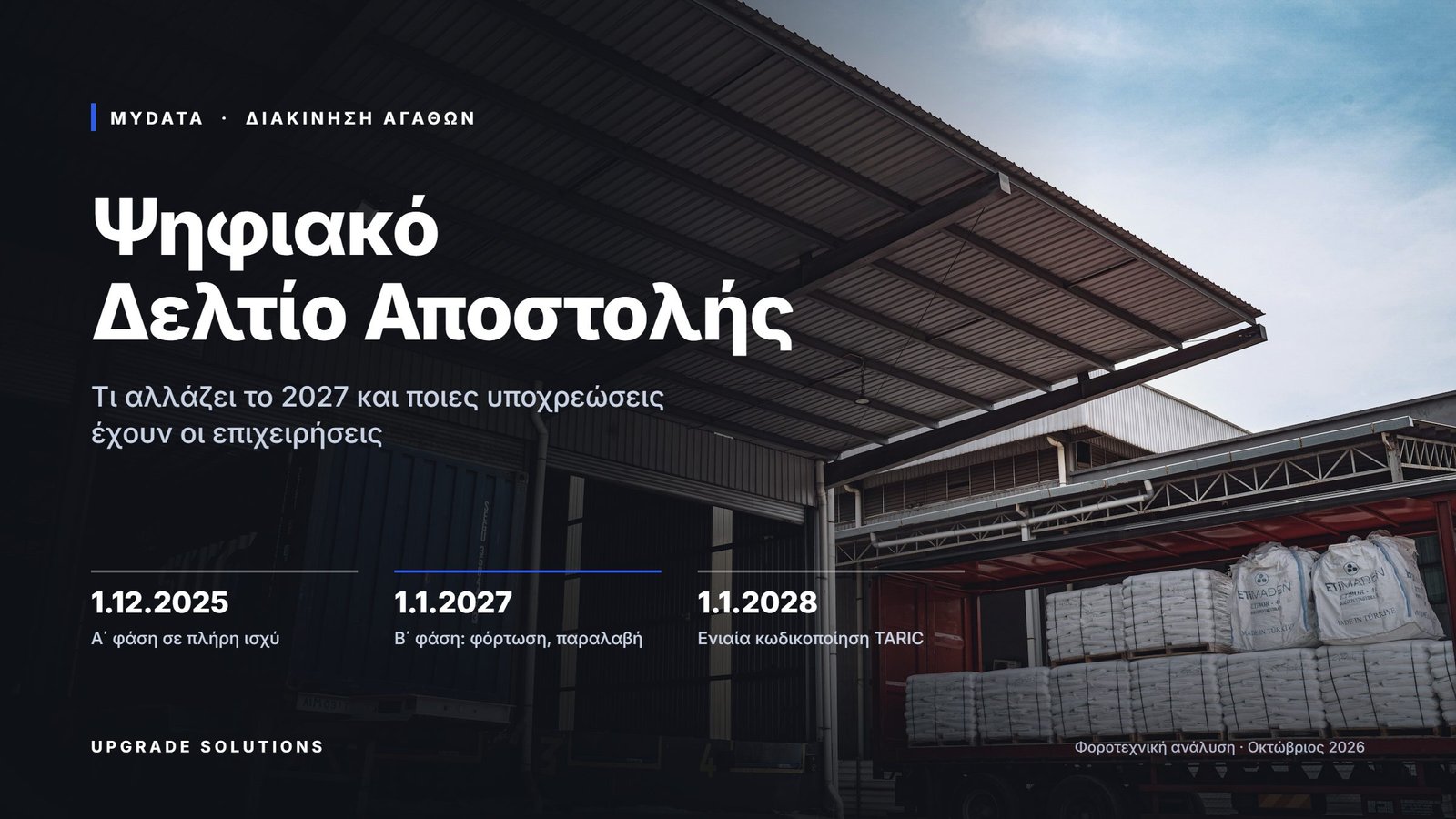
The same decisions also postponed Phase B of digital movement documents. From 1 January 2027, the loading, transshipment and receipt procedures, as well as the transmission of quantity-check data, are activated for all businesses. From 1 January 2028, uniform item coding based on the TARIC nomenclature follows. Any business that moves goods should plan the two transitions together.
For olive growers: the obligation to issue digital movement documents was also moved to 1/1/2027. The postponement applies provided that, on receiving the olives, the olive mill issues a quantity receipt note, and concerns those not in the first period.
E-invoicing: the steps we recommend
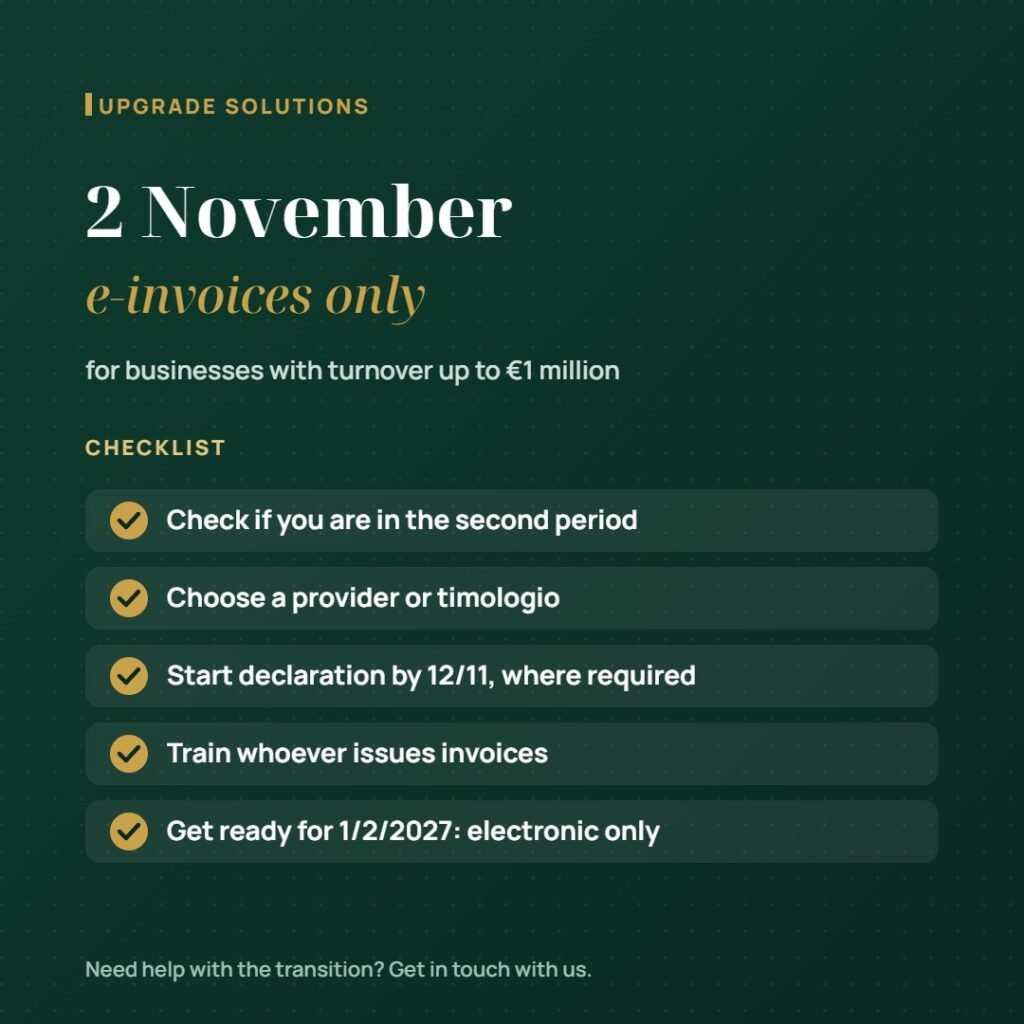
- Confirm whether you belong to the second period and whether you issue B2B or B2G invoices.
- Choose your route: a provider if you have an ERP, POS or many invoices; timologio if you issue only a few.
- If you go with a provider, sign a contract with a start date by 2/11/2026, grant the authorisation in Taxisnet and check that the declaration was filed by 12/11.
- If you go with timologio and want the adjustment period, file the declaration yourself by 12/11/2026.
- Run test invoices and train whoever issues invoices, so that on 1/2/2027 nothing needs to change.
Frequently asked questions
I only have retail sales. Do I need to do anything?
No. Retail transactions with consumers are not affected. But if you issue even one invoice to a business after 2/11/2026, it must be electronic, so it is wise to have an issuing method ready.
I already use timologio. Do I need a declaration?
No, if from 2/11/2026 you will issue your invoices exclusively from the application. A declaration is needed only if you want to continue in parallel with your old method until 31/1/2027.
Can I keep issuing from my ERP?
Yes, if the ERP connects to a certified e-invoicing provider: in that case you continue working normally from your software. What stops is the direct transmission of invoices from the ERP to myDATA without a provider. That is allowed only until 31/1/2027 and only if a timely declaration has been filed.
Are the tax incentives for early adoption still available?
For the second period, the deadline for the incentives (increased 100% deduction of the related expenses) was 3 August 2026 and has passed. The obligation, however, applies as normal.
I don’t have time to sign with a provider. What do I do?
Start with timologio with a start date by 2/11/2026 and file a declaration by 12/11 if you want the adjustment period. You can add a provider later, and it will then file its own declaration.
We help you with the transition
As part of our Tax Planning and Bookkeeping service, the Upgrade Solutions team checks whether the obligation applies to you, recommends the right solution, handles the declarations in myAADE and supports you with your first invoices. Contact us or email info@upgradesolutions.gr.
Read also: Digital delivery note: the Phase B dates · Self-employed in Greece: a guide for those starting now
Sources: AADE – announcement of new deadlines 30.09.2026 (decisions A.1197/2026 and A.1198/2026), decisions A.1128/2025, A.1129/2025, A.1112/2025, circular E.2004/2026.
This article is for information purposes only and does not replace specialised professional advice.